
Jeudi 15 mars 2018
Les premiers outils en Afrique
Dominique CAUCHE
Chercheur à l'Institut de Paléontologie Humaine
Laboratoire Nice-Côte d'Azur
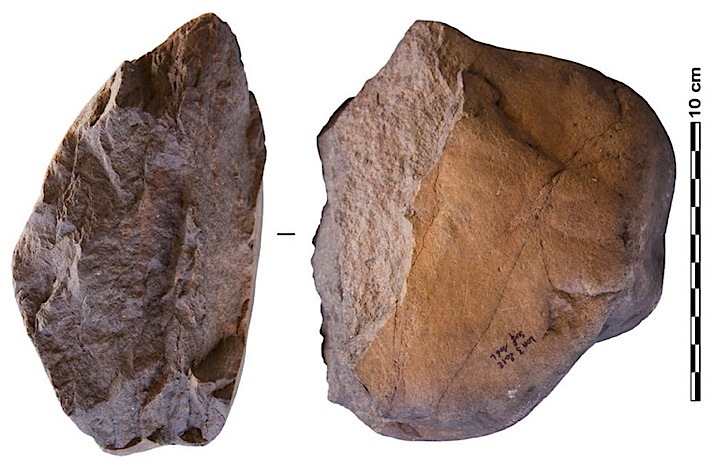
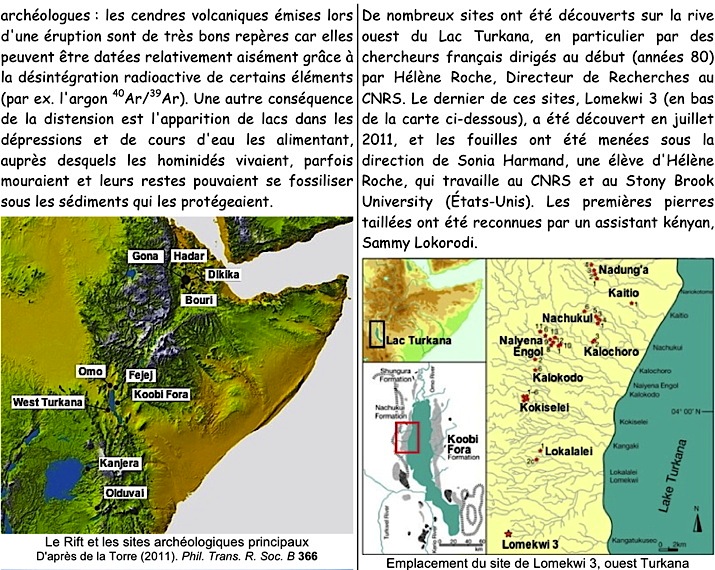
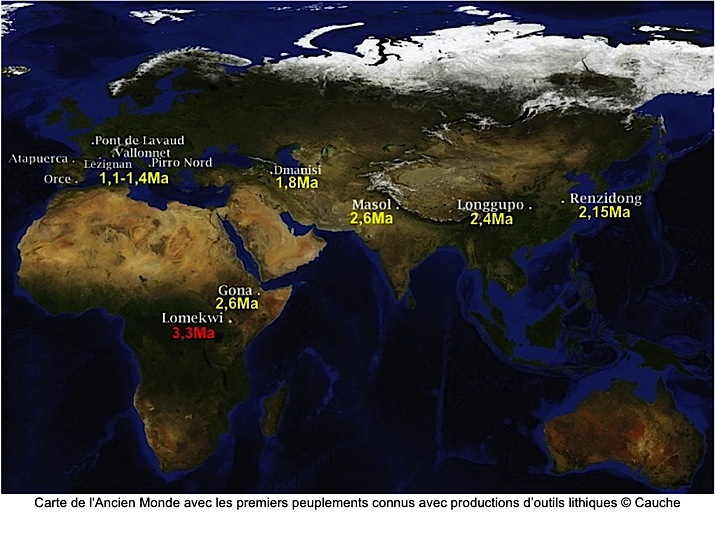
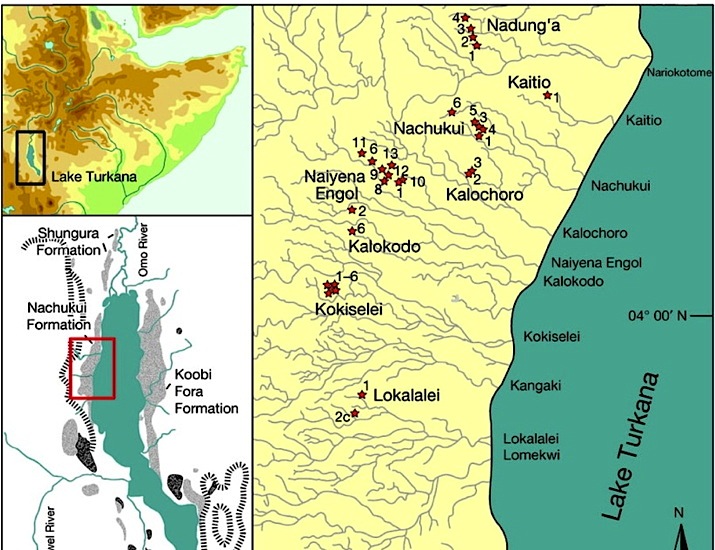
Outil en pierre taillée du site de Lomekwi (Lac Turkana, Kenya) daté de 3,3 Ma
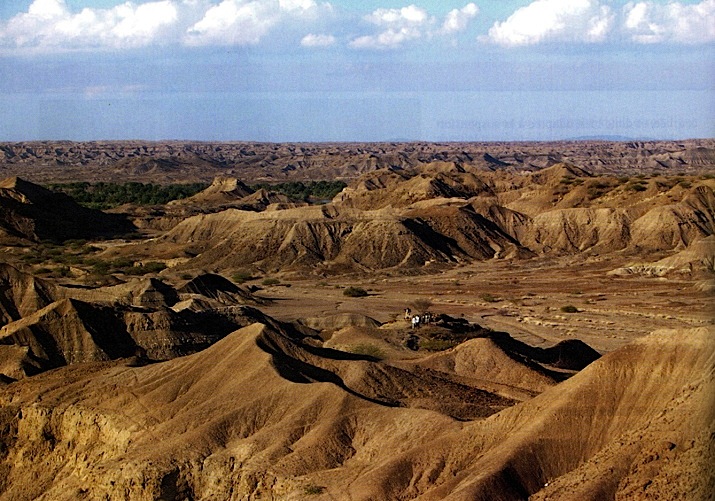
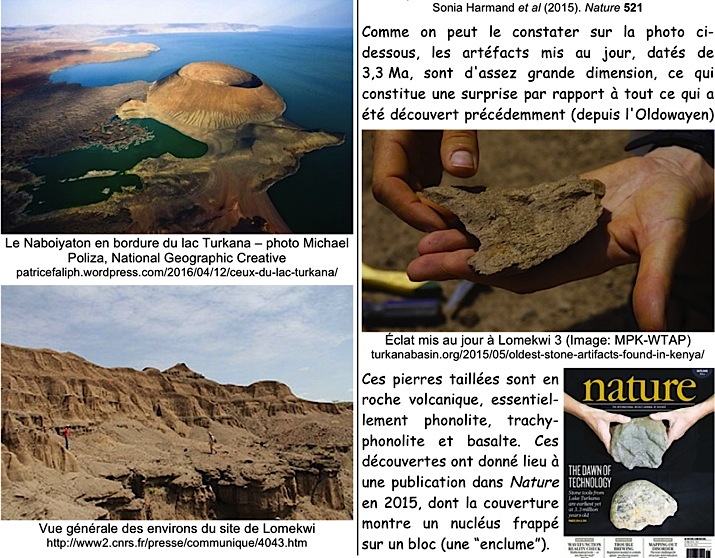
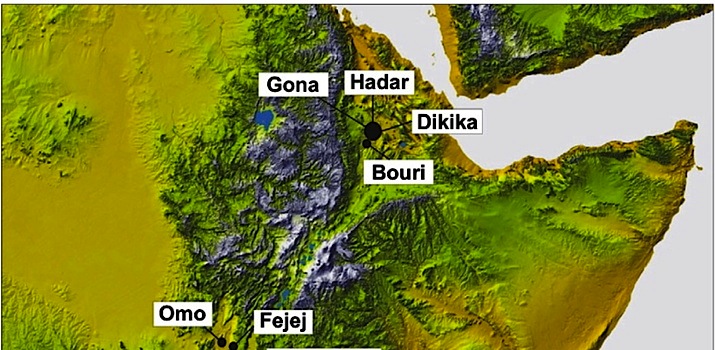
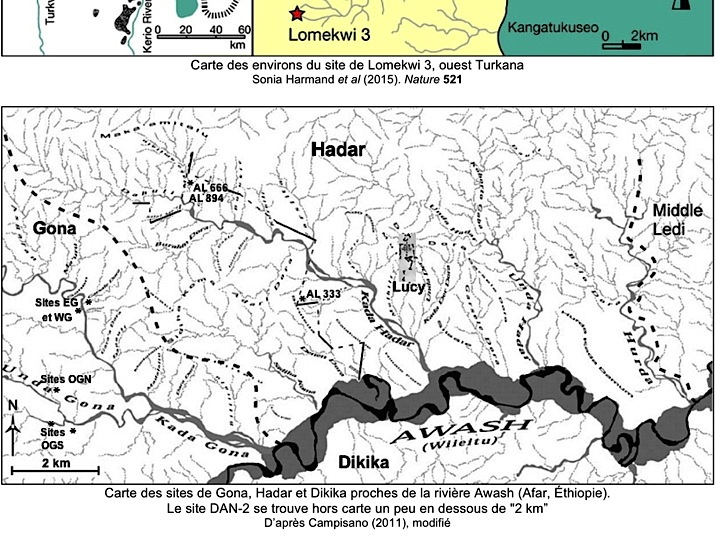
Site de fouilles à Dikika, en Afar (Éthiopie)
Document extrait du diaporama de D. Cauche
1
2
3
4
5

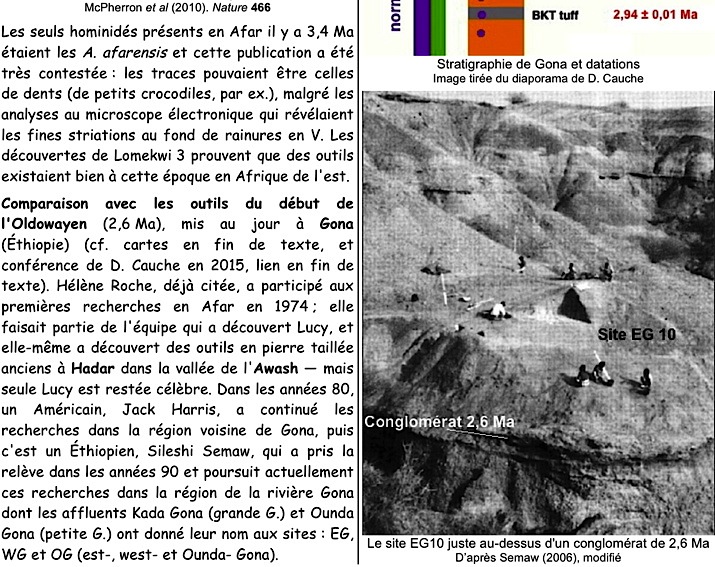
6
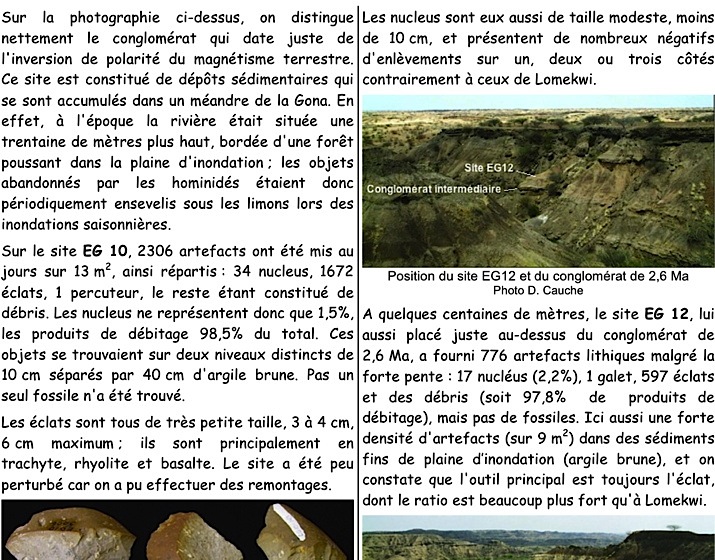
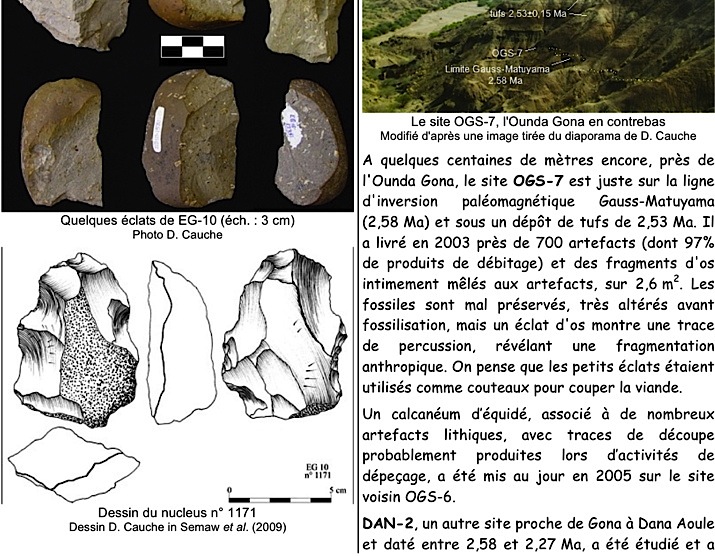
7
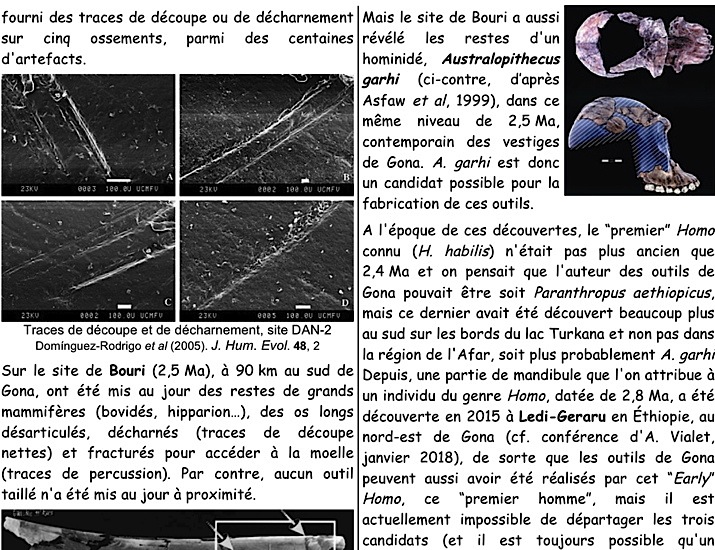
8
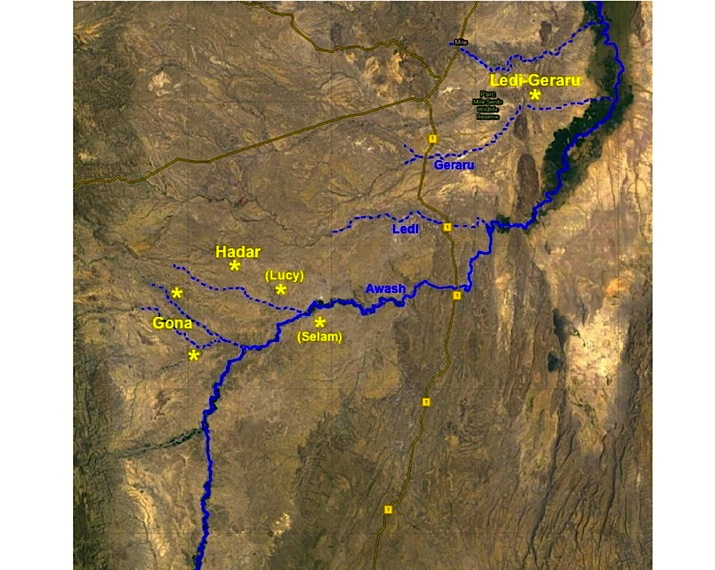
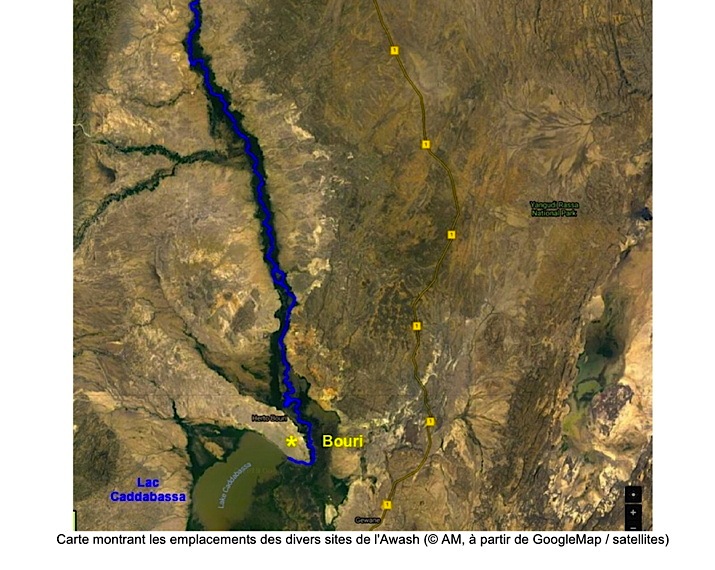
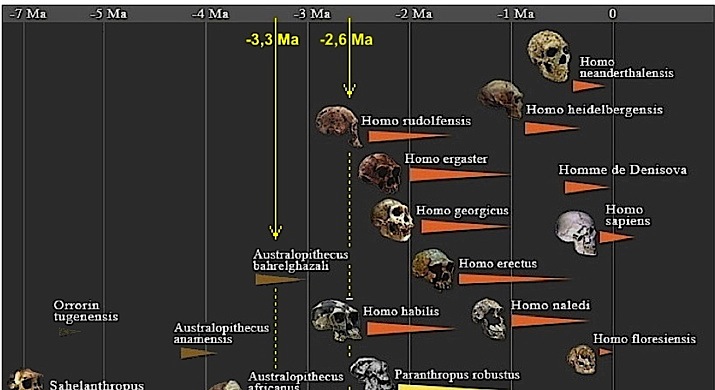
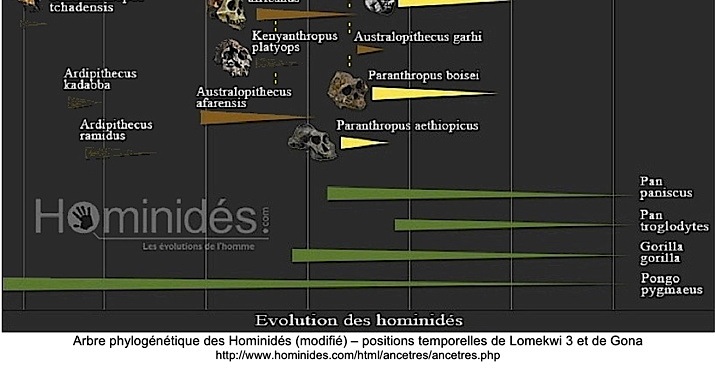
Sites web éventuels…
https://fr.wikipedia.org/wiki/Lac_Turkana
https://fr.wikipedia.org/wiki/Vallée_du_grand_rift
http://www2.cnrs.fr/presse/communique/4043.htm
http://www.lemonde.fr/archeologie/…/les-plus-anciens-outils-de-pierre-decouverts-au-kenya…
https://www.nature.com/articles/nature14464
https://www.nature.com/news/oldest-stone-tools-raise-questions-about-their-creators-1.17369
https://www.slashgear.com/see-the-worlds-oldest-stone-tools-up-close-21384696/ (qq images grand format)
http://worldancestors.blogspot.fr/2016/01/la-fin-de-lhomo-faber.html
https://www.nature.com/articles/nature09248 (traces de boucherie à Dikika, Afar)
http://www.ceptanice.fr/129+2015-1-decouverte-des-premiers-outils.html (conférence de D. Cauche, 2015, avec un mot sur le paléomagnétisme)
http://www.ceptanice.fr/183+2018-1-evolution-humaine.html (conférence de A. Vialet en janvier 2018)
Bibliographie communiquée par Dominique Cauche
Dambricourt Malassé A., Singh M., Karir B., Gaillard C., Bhardwaj V., Moigne A.M., Abdessadok S., Chapon Sao C., Gargani J., Tudryn A.,Calligaro T., Kaur A., Pal S., Hazarika M. (2016). Anthropic activities in the Quranwala Fossiliferous Zone, 2.6 Ma, Siwaliks of northwestern India, historical context of the discovery and the scientific investigations. C. R. Palevol 15, 295-316.
Han F., Bahain JJ., Deng C., Boëda E., Hou Y., Wei G., Huang W., Garcia T., Shao Q., He C., Falguères C., Voinchet P., Yin G. (2017). The earliest evidence of hominid settlement in China: Combined electron spin resonance and uranium series (ESR/U-series) dating of mammalian fossil teeth from Longgupo cave. Quaternary International 434, 75-83.
Michel V., Shen C.-C., Woodhead J., Hu H.-M., Wu C.-C., Moullé P.-E., Khatib S., Cauche D., Moncel M.-H., Valensi P., Chou Y.-M., Gallet S., Echassoux A., Orange F., Lumley H. de (2017). New dating evidence of the early presence of hominins in Southern Europe. Scientific Reports.
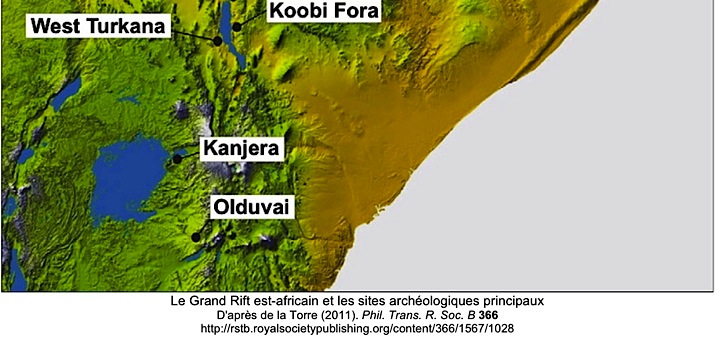
Torre, I. (2011). The origins of stone tool technology in Africa: a historical perspective. Phil. Trans. R. Soc. 366, 1028–1037.
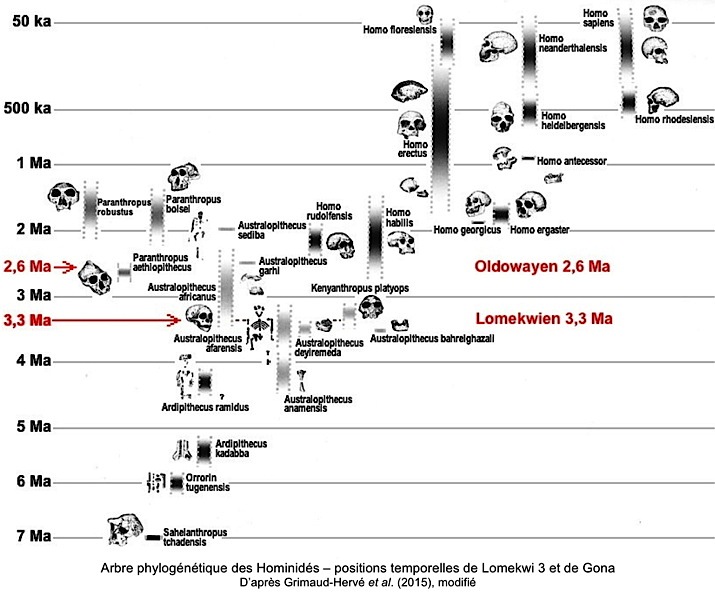
Harmand S. et al. (2015). 3.3-million-year-old stone tools from Lomekwi 3, West Turkana, Kenya. Nature 521, 310–315.
Lewis J. & Harmand S. (2016). An earlier origin for stone tool making: implications for cognitive evolution and the transition to Homo. Phil. Trans. R. Soc. B 371: 20150233.
McPherron S.P., Alemseged Z., Marean C.W., Wynn J.G., Reed D., Geraads D., Bobe R., Be´arat H. (2010). Evidence for stone-tool-assisted consumption of animal tissues before 3.39 million years ago at Dikika, Ethiopia. Nature 466, 857-860.
Semaw S. (2006). The oldest stone artifacts from Gona (2.6-2.5 Ma), Afar, Ethiopia: implications for understanding the earliest stages of stone knapping. In N. Toth and K. Schick (Eds) The Oldowan: Case Studies Into the Earliest Stone Age. Stone Age Institute Publication Series, Gosport, Chapter 2, 43-75.
Semaw S., Rogers M., Stout D. (2009). Insights into Late Piocene lithic assemblage variability: the East Gona and Ounda Gona South Oldowan Archaeology (2.6 Ma), Afar, Ethiopia. In N. Toth and K. Schick (Eds) The cutting edge: New Approaches to the Archaeology of Human Origins. Stone Age Institute Publication Series, Gosport, Chapter 11, 211-246.
Dominguez-Rodrigo M., Pickering T.R., Semaw S., Rogers M.J. (2005). Cutmarked bones from Pliocene archaeological sites at Gona, Afar, Ethiopia: implications for the function of the world’s oldest stone tools. Journal of Human Evolution 48 (2), 109–121.
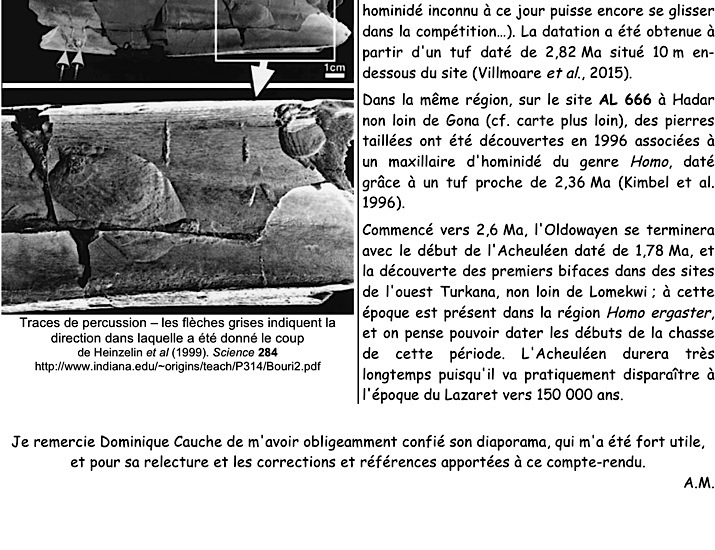
de Heinzelin J., Clark J.D., White T., Hart W., Renne P., WoldeGabriel G., Beyene Y., Vrba E. (1999). Environment and behavior of 2.5-million-year-old Bouri hominids. Science 284, 625–629.
Asfaw B., White T., Lovejoy O., Latimer B., Simpson S., Suwa G. (1999). Australopithecus garhi: a new species of Early Hominid from Ethiopia. Science 284, 629-635.
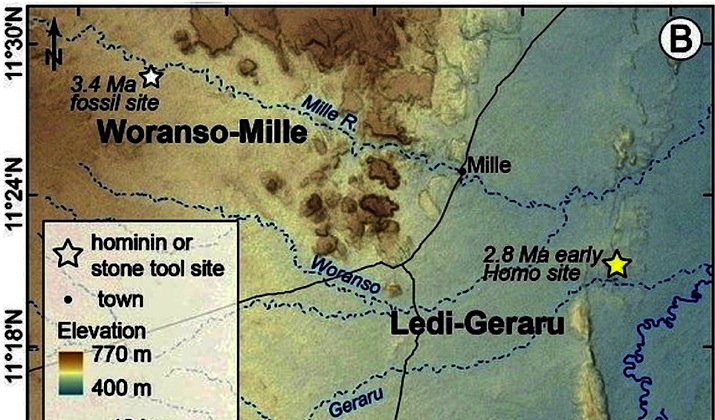
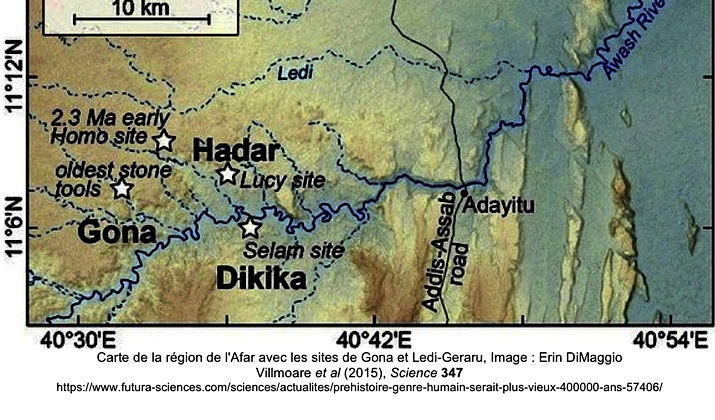
Villmoare, B. et al. (2015). Early Homo at 2.8 Ma from Ledi-Geraru, Afar, Ethiopia. Science 347, 1352–1355.
Kimbel W.H., Walter R.C., Johanson D.C., Reed K.E., Aronson J.L., Assefa Z., Marean C.W., Eck G.C., Bobe R., Hovers E., Rak Y., Vondra C., Yemane T., York D., Chen Y., Evensen N.M., Smith P.E. (1996). Late Pliocene Homo and Oldowan tools from the Hadar Formation (Kada Hadar Member), Ethiopia. Journal of Human Evolution 31, 549–561.
Grimaud-Hervé D., Serre F., Bahain J.-J., Nespoulet R., Pigeaud R. (2015). Histoires d’ancêtres. La grande aventure de la Préhistoire. Editions Errance, Arles, 144 p.
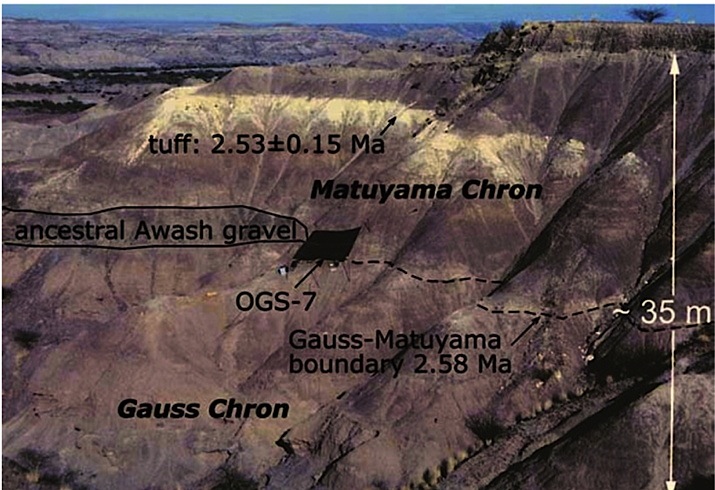
Stout D., Quade J., Semaw S., Rogers M., Levin N. (2005). Raw material selectivity of the earliest stone toolmakers at Gona, Afar, Ethiopia. Journal of Human Evolution 48, 365-380.
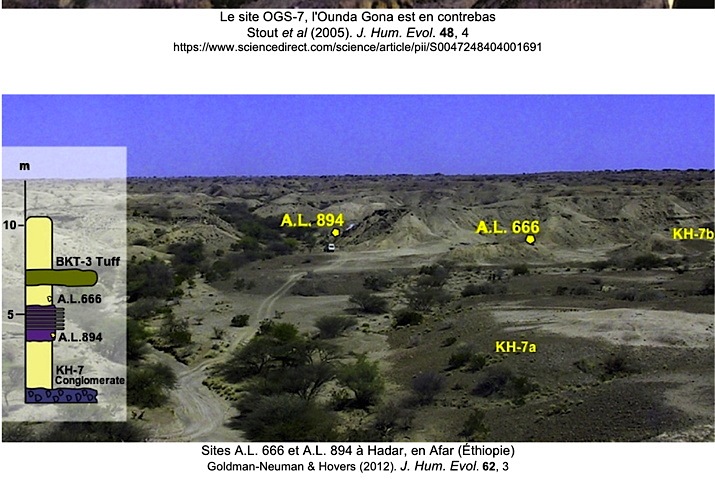
Goldman-Neuman T., Hovers E. (2012). Raw material selectivity in Late Pliocene Oldowan sites in the Makaamitalu Basin, Hadar, Ethiopia. Journal of Human Evolution 62, 353-366.
Mots-clés : Afar, Éthiopie, Lac Turkana, Kenya, Hélène Roche, Sonia Harmand, Grand Rift est-africain, Lomekwi 3, éclat, nucleus, percuteur fixe, Oldowayen, Lomekwien, Dikika, Gona, Bouri, découpe, décharnement, A. garhi, Ledi-Geraru, Hadar


Réagir