
Jeudi 3 mai 2018
Les peuplements préhistoriques en Asie-Pacifique :
l’homme à la conquête d’autres mondes
Hubert FORESTIER
Professeur au Muséum national d’Histoire naturelle
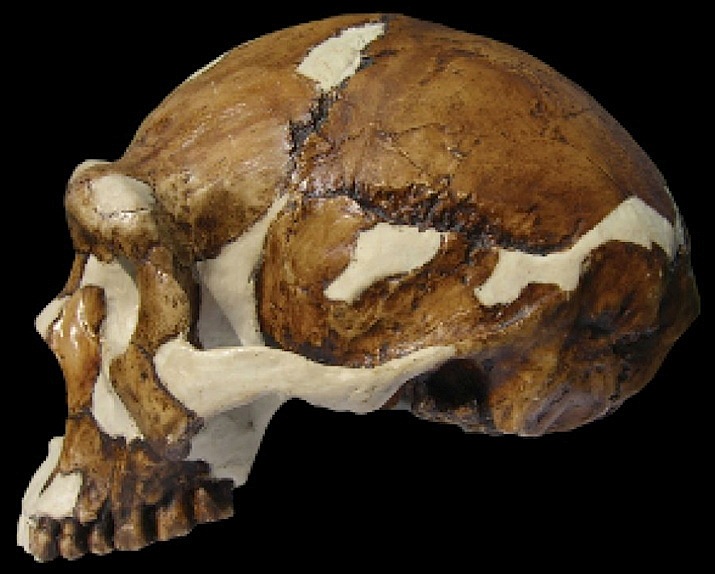
Homo erectus du site de Zhoukoudian, l'Homme de Pékin, daté de 700 000 ans
https://www.sciencesetavenir.fr/archeo-paleo/200-000-ans-de-plus-pour-l-homme-de-pekin_21122
1
2
3
4
5
6
7
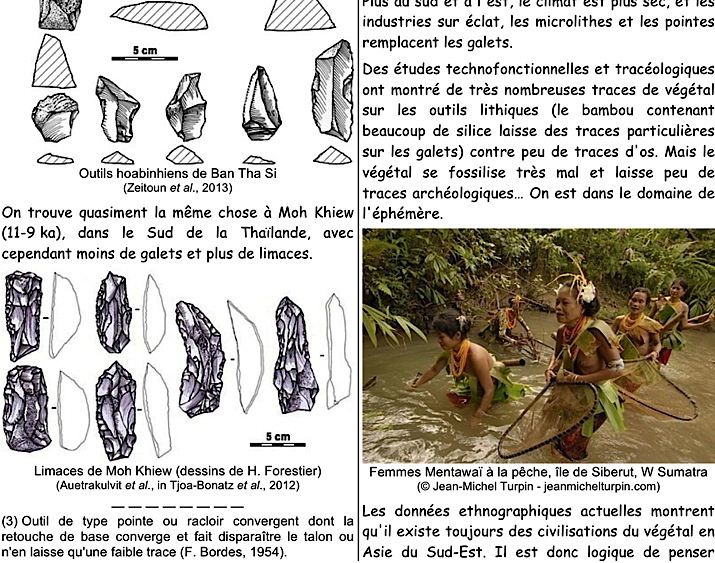
8
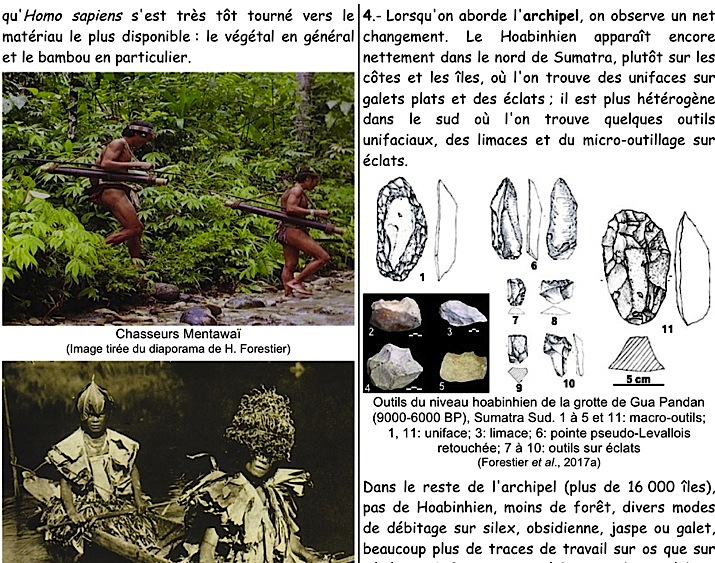
9
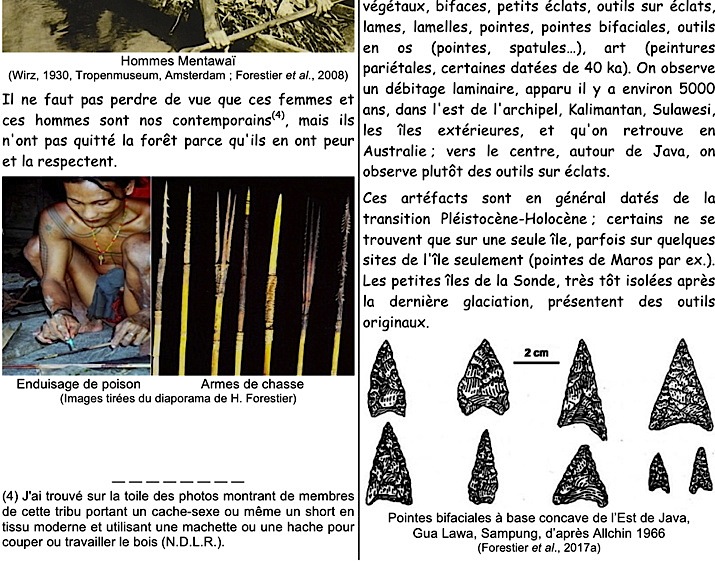
10
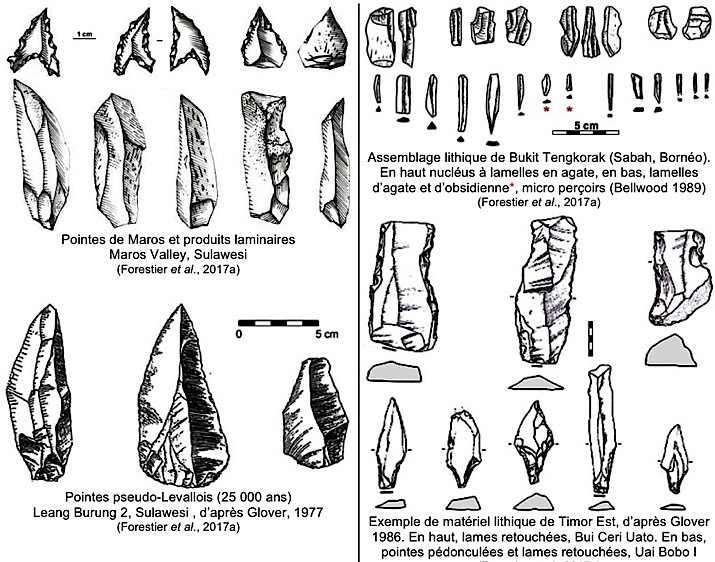
11
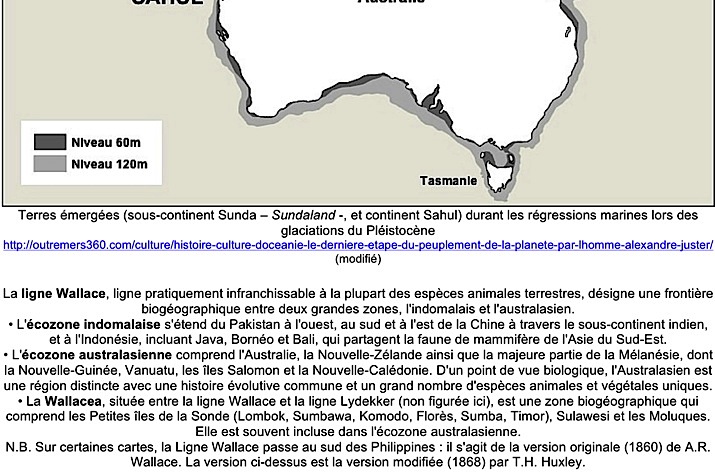
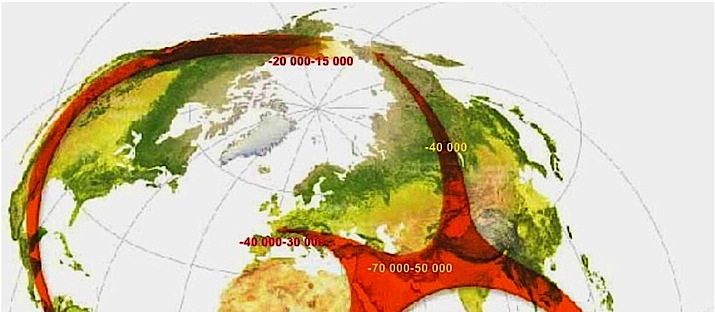
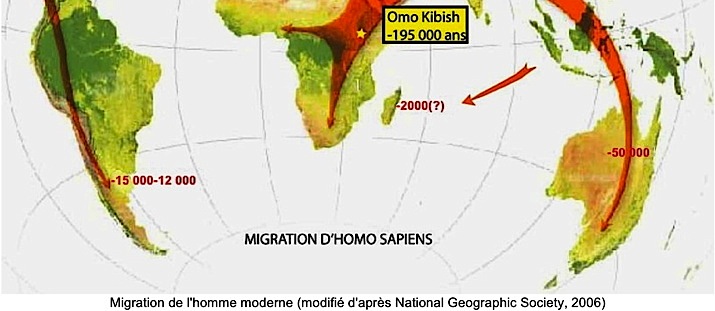
https://www.u-picardie.fr/beauchamp/conferences/La_lignee.html
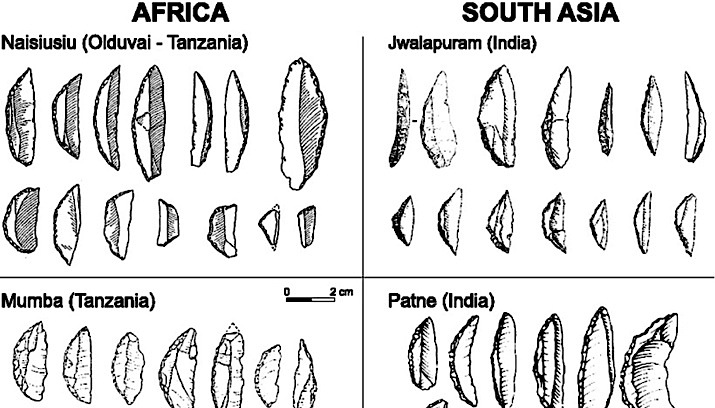
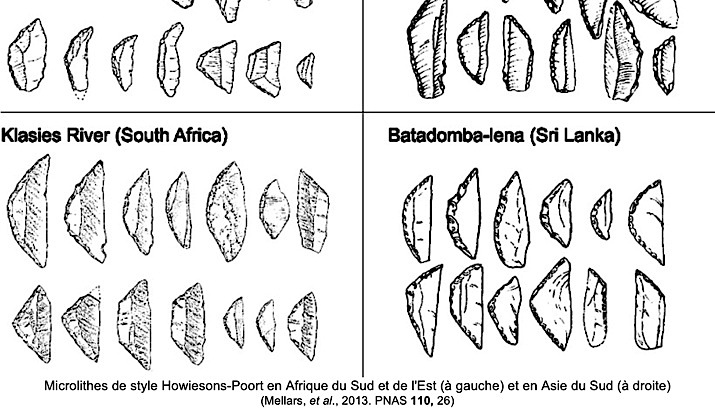
https://www.pnas.org/content/110/26/10699
Sites web consultés…
https://fr.wikipedia.org/wiki/Sahul
https://fr.wikipedia.org/wiki/Sunda_(géologie)
https://fr.wikipedia.org/wiki/Ligne_Wallace
http://humanorigins.si.edu/research/asian-research-projects/hobbits-flores-indonesia
https://fr.wikipedia.org/wiki/Homme_de_Florès
http://www.hominides.com/html/actualites/homo-floresiensis-disparu-il-y-a-50000-ans-1024.php
https://www.hominides.com/html/actualites/homo-floresiensis-ancetre-700000-ans-1040.php
http://www.hominides.com/html/actualites/origines-homo-floresiensis-habilis-1129.php
https://fr.wikipedia.org/wiki/Homme_de_Denisova
https://en.wikipedia.org/wiki/Riwat
https://fr.wikipedia.org/wiki/Masol
http://www.hominides.com/html/actualites/espece-humaine-himalaya-inde-2-6-millions-1006.php
http://www.hominides.com/html/actualites/outils-preuve-presence-hominides-asie-0422.php
https://www.hominides.com/html/actualites/des-outils-en-chine-2-1-millions-shangchen-1251.php (Des outils de 2,1 Ma en Chine, Nature, 11/7/2018)
https://www.universalis.fr/encyclopedie/site-archeologique-d-attirampakkam-inde/
https://fr.wikipedia.org/wiki/Homme_de_Wushan (à propos de la controverse sur la mandibule de Longgupo)
https://fr.wikipedia.org/wiki/Homme_de_Yunxian
https://journals.openedition.org/quaternaire/5815?file=1
http://eprints.unife.it/831/1/Purnomo_tesi.pdf (A. Purnomo, 2013. Thèse)
http://www.elishean.fr/une-civilisation-du-vegetal-inconnue-en-asie-du-sud-est/
https://www.hominides.com/html/actualites/homo-sapiens-300000-ans-maroc-1149.php (Djebel Irhoud)
https://www.nature.com/news/oldest-homo-sapiens-fossil-claim-rewrites-our-species-history-1.22114 (Djebel Irhoud)
https://www.hominides.com/html/actualites/homo-sapiens-misliya-175-200000-ans-israel-1198.php (Misliya)
http://science.sciencemag.org/content/359/6374/456 (Misliya)
https://www.pourlascience.fr/sd/prehistoire/i-homo-sapiens-i-a-precede-de-tres-loin-i-homo-neanderthalensis-i-au-levant-12769.php (Misliya et Proche Orient)
https://www.hominides.com/html/actualites/homme-zhirendong-presence-chine-100000-ans-0363.php (Chine)
https://www.hominides.com/html/actualites/homo-sapiens-chine-260000-ans-1184.php (Chine)
https://en.wikipedia.org/wiki/Zhiren_Cave (Chine)
https://www.researchgate.net/publication/47806842_The_oldest_and_longest_enduring_microlithic_sequence_in_India_35_000_years_of_modern_human_occupation_and_change_at_the_Jwalapuram_Locality_9_rockshelter (Clarkson et al., 2009)
http://www.academia.edu/7321724/Jwalapuram_and_Middle_Palaeolithic et
https://www.researchgate.net/publication/49513283_Indian_lithic_technology_prior_to_the_74000_BP_Toba_super-eruption_Searching_for_an_early_modern_human_signature (Haslam et al., 2010)
https://en.wikipedia.org/wiki/Balangoda_Man
https://fr.wikipedia.org/wiki/Lœss
https://www.persee.fr/doc/bspf_0249-7638_1954_num_51_7_3107 (F. Bordes, 1954)
https://books.google.fr/books?id=Cq3GBgAAQBAJ&pg=PR9&lpg=PR9&dq="Moh+Khiew"&source=bl&ots=c1WfLK3e9B&sig=xDWoFddHZyrOy61gjVkr5Qc726c&hl=fr&sa=X&ved=2ahUKEwiZj8rZtuPfAhXp2OAKHdGpBKQQ6AEwDHoECAUQAQ - v=onepage&q="Moh Khiew"&f=false (Auetrakulvit et al., 2012)
https://www.futura-sciences.com/sciences/actualites/prehistoire-civilisation-vegetal-inconnue-asie-sud-71339/ (Une civilisation du végétal inconnue en Asie du sud-est ?)
https://journals.openedition.org/echogeo/4548 (Les dessous de l’espace. Un dialogue archéologique entre le temps, les techniques et l’espace. Communication d'Hubert Forestier)
https://www.ncbi.nlm.nih.gov/pmc/articles/PMC3991479/ (génome aborigènes)
http://biology-web.nmsu.edu/~houde/general and commensal model.pdf (ADN et peuplement du Pacifique)
Bibliographie
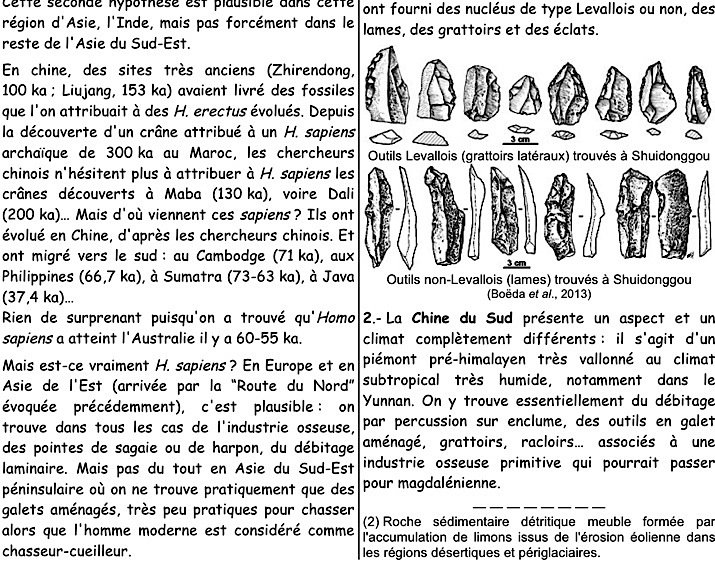
BOËDA E. et al. (dont H. FORESTIER), 2013. Levallois and non-Levallois blade production at Shuidonggou in Ningxia, North China. Quaternary International, 295, pp. 191-203. (http://lveho.ivpp.cas.cn/kycg/lw/201404/P020140409537395060652.pdf)
BRUMM A. et al. (dont VAN DEN BERGH G.), 2016. Age and context of the oldest known hominin fossils from Flores. Nature, 534, pp 249–253. (Résumé : https://www.nature.com/articles/nature17663)
DOYON L. et al., 2018. Discovery of circa 115,000-year-old bone retouchers at Lingjing, Henan, China. PLoS ONE, 13(3). (https://journals.plos.org/plosone/article?id=10.1371/journal.pone.0194318)
FORESTIER H., 2000. De quelques chaînes opératoires lithiques en Asie du Sud-Est au pléistocène supérieur final et au début de l'holocène. L'Anthropologie, 104, 4, pp 531-548. (Résumé : https://www.sciencedirect.com/science/article/pii/S0003552100800254)
FORESTIER H. & PATOLE-EDOUMBA E., 2000. Les industries lithiques du Paléolithique tardif et du début de l'Holocène en Insulinde. Aséanie. Sciences humaines en Asie du Sud-Est, 6, pp 13-56. (https://www.persee.fr/doc/asean_0859-9009_2000_num_6_1_1683)
FORESTIER H., 2003. Des outils nés de la forêt. in FROMENT A. & GUFFROY J. (dir.), 2003. Peuplements anciens et actuels des forêts tropicales. IRD Éditions, Marseille. pp 315-337. (https://books.openedition.org/irdeditions/1551?lang=fr)
FORESTIER H., ZEITOUN V., LENOBLE A. & TIAMTINKRIT C., 2006. Discovery of new old material in the basaltic region of lampang (northern thailand): a techno-functional interpretation. 11th International Conference of the Eurasea. Bougon, France. (https://halshs.archives-ouvertes.fr/halshs-00423516/document)
FORESTIER H., GRENET M., BOREL A. & CELIBERTI V., 2017a. Les productions lithiques de l’Archipel indonésien. Journal of Lithic Studies, 4, 2, pp 231-303. (http://journals.ed.ac.uk/lithicstudies/article/view/2544/3753)
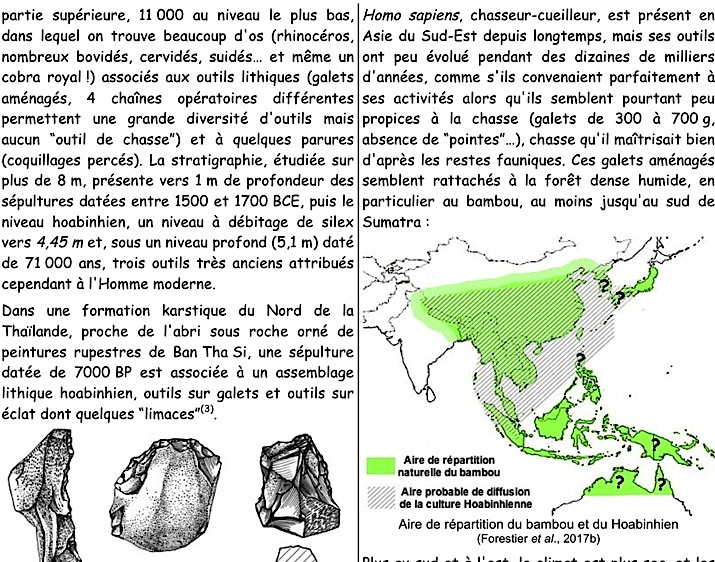
FORESTIER H., SOPHADY H. & CELIBERTI V., 2017b. Le techno-complexe hoabinhien en Asie du Sud-est continentale : L’histoire d’un galet qui cache la forêt. Journal of Lithic Studies, 4, 2, pp 305-349. (http://journals.ed.ac.uk/lithicstudies/article/view/2545/3742)
HOLEN S.R. et al., 2017. A 130,000-year-old archaeological site in southern California, USA. Nature, 544, pp 479–483. (Résumé : https://www.nature.com/articles/nature22065)
INGICCO T. et al. (dont H. FORESTIER), 2018. Earliest known hominin activity in the Philippines by 709 thousand years ago. Nature, 557, pp 233–237. (Résumé : https://www.nature.com/articles/s41586-018-0072-8 ; article d'Hominides.com : http://www.hominides.com/html/actualites/outils-philippines-709000-ans-1229.php)
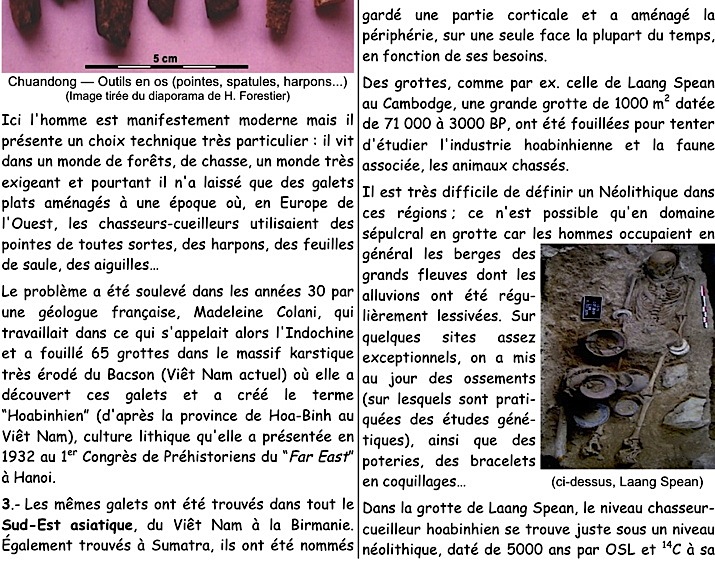
JI X. et al. (dont H. FORESTIER), 2016. The oldest Hoabinhian technocomplex in Asia (43.5 ka) at Xiaodong rockshelter, Yunnan Province, southwest China. Quaternary International, 400,, pp. 166-174. (https://www.researchgate.net/publication/287966708_The_oldest_Hoabinhian_technocomplex_in_Asia_435_ka_at_Xiaodong_rockshelter_Yunnan_Province_southwest_China)
LIU W. et al., 2015.The earliest unequivocally modern humans in southern China. Nature, 526, pp 696–699. (Résumé : https://www.nature.com/articles/nature15696)
MELLARS P. et al., 2013. Genetic and archaeological perspectives on the initial modern human colonization of southern Asia. PNAS, 110(26), pp. 10699-10704. (https://www.pnas.org/content/110/26/10699)
MELLARS P., (date non référencée). Models for the Modern Human Colonisation of South Asia: Genetic and Archaeological Perspectives. (Présentation PDF : http://indico.ictp.it/event/a10265/material/3/3.pdf)
MICHEL V. et al. (dont Patricia VALENSI), 2016. The earliest modern Homo sapiens in China? Journal of Human Evolution, 101, pp 101-104. (https://www.researchgate.net/publication/307465372_The_earliest_modern_Homo_sapiens_in_China)
SOPHADY H. et al. (dont H. FORESTIER), 2016. Laang Spean cave (Battambang province): A tale of occupation in Cambodia from the Late Upper Pleistocene to Holocene. Quaternary International, 416, pp. 162-176. (https://www.researchgate.net/publication/283433092_Laang_Spean_cave_Battambang_province_A_tale_of_occupation_in_Cambodia_from_the_Late_Upper_Pleistocene_to_Holocene)
VAN DEN BERGH G.D. et al., 2016a. Earliest hominin occupation of Sulawesi, Indonesia. Nature, 529, pp 208–211. (Résumé : https://www.nature.com/articles/nature16448)
VAN DEN BERGH G.D. et al., 2016b. Homo floresiensis-like fossils from the early Middle Pleistocene of Flores. Nature, 534, pp 245–248. (Résumé : https://www.nature.com/articles/nature17999)
VAN DEN BERGH G. & BRUMM A., 2016. La découverte d’un fossile vieux de 700 000 ans montre que les ancêtres du Hobbit étaient encore plus petits. (https://theconversation.com/la-decouverte-dun-fossile-vieux-de-700-000-ans-montre-que-les-ancetres-du-hobbit-etaient-encore-plus-petits-60962)
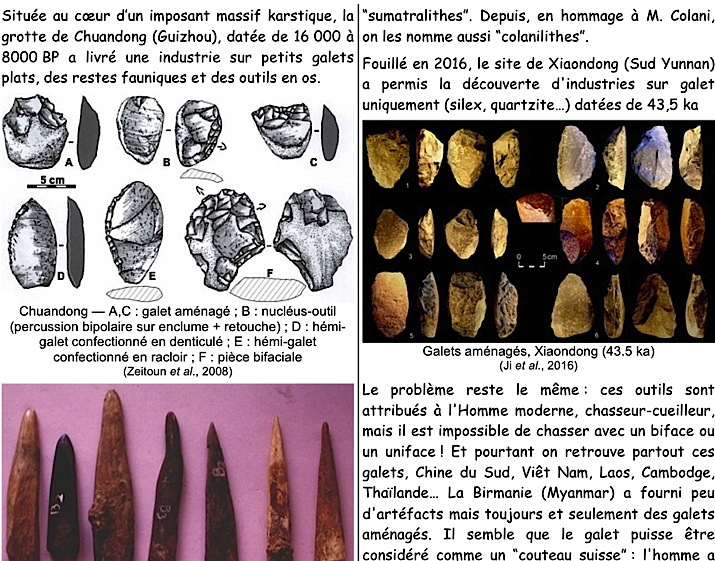
ZEITOUN V., FORESTIER H. & NAKBUNLUNG S. (dir.), 2008. Préhistoires au sud du Triangle d’or. IRD Éditions, Marseille, 252 p. (https://books.openedition.org/irdeditions/1818)
Chapitre 1. Théories, modèles et controverses sur les premiers humains en Asie du Sud-Est
Chapitre 2. Technologie de la pierre taillée en Asie du Sud-Est
Chapitre 3. Les grands mammifères comme marqueurs privilégiés
Chapitre 4. Les grottes du nord de la Thaïlande
ZHU Z.Y. et al., 2018. Hominin occupation of the Chinese Loess Plateau since about 2.1 million years ago. Nature, 559, pp 608–612. (Résumé : https://www.nature.com/articles/s41586-018-0299-4)
Mots-clés : sud-est asiatique, archipel indonésien, Sunda, Sahul, floresiensis, Florès, Denisova, Longgupo, Modjokerto, Sangiran, Java, Kalinga, Philippines, Baturaja, Liang Bua, Mata Menge, Sibudu, Enkapune ya Muto, Jwalapuram, Balangoda Man, Batadombalena, Shuidonggou, Chuandong, Xiaondong, Laang Spean, Ban Tha Si, Moh Khiew, bambou, civilisation du végétal


Les réactions
Pierre, Cormier
Le 04/02/2019 à 19:39:50
Étonnantes études synthétiques. Cela vous en impose !
Réagir